On this page
- The scale we don't see
- Everyone is doing their part. So why isn't it getting better?
- That is what motivated us to build EarthReheal
- What one handover looks like
- Where the waste journey begins
- The collector: the most underestimated link
- The recovery centre: where the middle gets ignored
- The recycler and scrap dealer: where invisible work lives
- The landfill is the symptom, not the cause
- Citizens aren't outside the system. They are where it starts.
- Why hasn't this existed before?
- This is a cause, not a contest
- Better late than never. Every tonne counts.
- Where to start
Every day, hundreds of millions of Indians do something so ordinary it barely registers. They throw something away: a food scrap, a plastic bottle, a cardboard box, an old phone.
Once it leaves our hands, most of us stop thinking about it. But that is where the real story begins.
The scale we don't see
The Central Pollution Control Board's latest annual report on solid waste management (2022-23) puts what India generates at about 1,70,939 tonnes a day. Of that, the report, using data supplied by the State Pollution Control Boards, records 61% as processed or treated and 22% as disposed of in sanitary landfills. The remaining 17%, about 28,576 tonnes a day, is unaccounted for: the board's own term for waste that is neither treated nor landfilled in a recognised facility. Disposal at an open dumpsite is not a recognised route under the rules, so it appears in neither of the first two figures.
You can see the results in overflowing bins and polluted waterways, and in landfills that have grown to enormous heights and, in summer, catch fire and cover neighbourhoods in smoke. Organic waste decomposes without oxygen and produces methane. Leachate, the toxic liquid it produces, can reach groundwater.
And much of the material that reaches those landfills was recyclable, compostable, reusable or otherwise recoverable.
When we talk about pollution, we often look for a visible villain: the factory chimney, the industrial plant, the large dump site. But the everyday waste leaving millions of homes, offices, hotels, schools and campuses adds up to an enormous problem. No single household looks like a major polluter, so the problem becomes everybody's, and therefore nobody's.
Everyone is doing their part. So why isn't it getting better?
Look at the people involved, and it seems the whole country is already working on the problem. Households are trying to segregate. Collectors are picking up what is put out. Material recovery centres are sorting what they can. Scrap dealers and recyclers are recovering valuable material. NGOs are organising cleanup drives. Municipal and private agencies are keeping collection and processing moving, often with limited resources.
And yet the landfills keep growing, recyclable material still ends up where it shouldn't, and the same problems come back year after year.
The uncomfortable truth is that nobody can clearly see why.
- Is it poor segregation at the source?
- Is mixed collection undoing the good work of households?
- Are recovery facilities receiving material they cannot process?
- Is there not enough recycling capacity?
- Is something reusable being treated as waste?
- Or is the right information simply not reaching the person who needs it?
In different places and at different times, the answer may be all of these. The problem is that we don't have enough visibility to know which one, where, and how much.
We can measure waste in aggregate: what is generated, what reaches facilities, what reaches landfills. What is much harder to see is the journey in between, from the moment something leaves a household or organisation to the moment it is recovered, reused, recycled or buried. Without that visibility, every effort remains disconnected. We risk applying a broad solution to a very specific problem, and working hard on the wrong part of the system.
That is what motivated us to build EarthReheal
Our objective isn't simply to create another system that records where waste went. It is to make the waste lifecycle visible enough to understand where the system can improve, and what kind of improvement is needed.
Knowing that something reached a landfill is useful. Knowing why it reached the landfill when it could have been recovered is far more useful.
What one handover looks like
When waste moves from one participant to another through EarthReheal, both sides can confirm the handover. The record carries photographic evidence and a timestamp, creating a digital trail of what was handed over, when, and to whom. Once submitted, it cannot be quietly edited later: a correction is a new version, and the original stays in the history.
Where the next participant isn't on the platform yet, the handover can still be recorded and supported with an invoice, so the trail does not simply disappear because one participant has not yet joined.
When a handover is refused or the material is rejected, that is logged too. We deliberately do not ask collectors to grade every household's bin every day. That would add a heavy task to a day that is already long. A light record of what was handed over, and what was turned away, is enough.
Connect those handovers together and the journey becomes visible: not just the final destination, but the movement between the people and organisations involved.
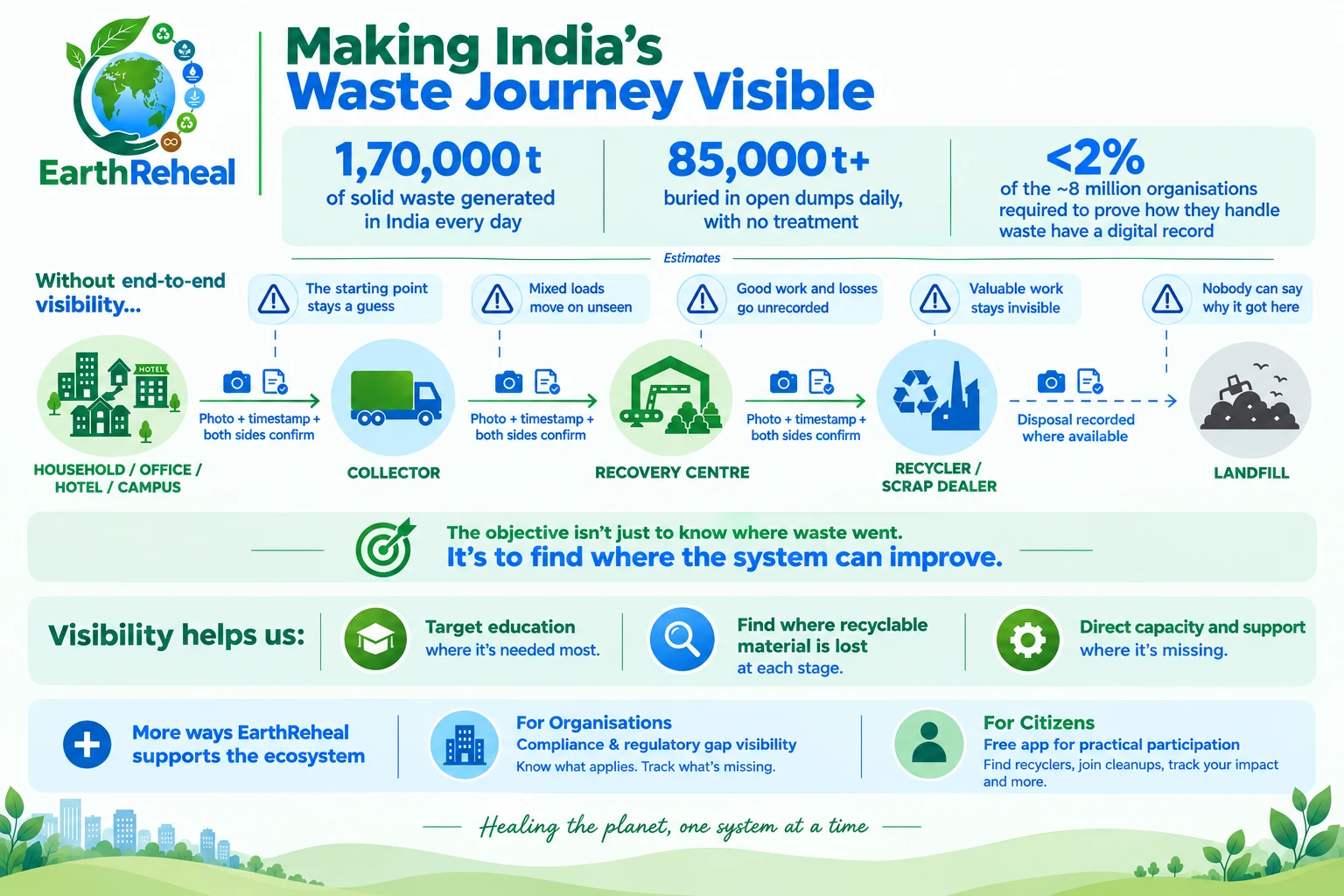
That visibility can answer much more useful questions.
- If rejections keep clustering around one kind of material, we can ask whether the cause is segregation, collection, or processing capacity.
- If recyclable material is repeatedly lost at a particular stage, that process can be examined.
- If one stage keeps turning material away, we can see what support or capacity it needs.
- If reusable material keeps entering the waste stream, we can step in earlier.
The objective is not just to know where waste went. It is to find where the system can improve.
Where the waste journey begins
Every waste journey starts somewhere: a household kitchen, an office pantry, a hotel back-of-house area, a school canteen, a hospital, a commercial building. What happens at that first point can make everything downstream easier, or harder.
Without a system, waste can leave the premises with little reliable evidence of what was actually handed over. If something goes wrong later, it is difficult to know where the problem started. With EarthReheal, the handover is documented, and organisations can keep their own segregation records as part of daily operations.
That doesn't magically solve segregation. But it changes the question. Instead of simply saying "people need to segregate better," we can begin asking where better education is actually needed, using the signals that appear downstream, such as what is being rejected and where.
Software alone won't create good habits. Education matters, which is why practical guidance is an important part of the citizen experience too: what belongs in wet waste, what is recyclable, what should be reused, donated, repaired or handled differently. The goal isn't to record bad behaviour. The goal is to find where better information can create better behaviour.
The collector: the most underestimated link
Collectors sit at one of the hardest points in the system. If they accept everything, mixed waste continues downstream. If they refuse it, waste may simply pile up on the street. So, very often, they accept it, and the problem moves on.
Collectors need to be empowered, not blamed. That is why we kept their part of the process light: a collector confirms the handover and records anything that has to be refused. They are not asked to inspect and score every household every day.
That small record still has value. When rejections are logged, a collector has evidence for a conversation about segregation, not just an argument. And across many handovers, it begins to show what is being turned away and where, so effort can go to the places that need it.
The recovery centre: where the middle gets ignored
Large facilities in major cities already operate sophisticated systems. But many smaller and medium-sized recovery operators handle a significant share of actual processing with far less digital infrastructure.
Without simple documentation, it is hard to show what they received, what they recovered and where material went next, so we lose visibility into both the good work being done and the problems holding it back. EarthReheal is designed to extend that visibility without requiring every participant to operate like a large enterprise. The point isn't to impose another complicated system. It is to connect the existing ecosystem well enough to understand where recovery is working, where it is failing, and what capacity or support is needed.
The recycler and scrap dealer: where invisible work lives
Scrap dealers, aggregators and informal and semi-formal recyclers recover enormous amounts of material and keep much of it away from landfill. A great deal of that work happens outside formal digital systems. Material changes hands, payment is made, material is recovered, and the useful information disappears.
With a connected record, more of that work becomes visible: not because people need to be digitised for the sake of technology, but because valuable work needs to be visible if the wider system is going to learn from it and build on it.
The landfill is the symptom, not the cause
Landfill is where many earlier failures finally add up. So when recyclable or reusable material reaches a landfill, the most important question isn't "where did it go?" It is "why did it get here?"
That changes the conversation, from "we have too much waste" to "here is where the system is losing recyclable, reusable or recoverable material, and here is where we may be able to intervene." That is what traceability is really for: not simply knowing where waste went, but knowing enough about its journey to make the next journey better.
Citizens aren't outside the system. They are where it starts.
Every waste journey begins with a person deciding what to do with something they no longer want. That is why the EarthReheal App is a core part of what we are building, not an add-on, and it is free.
A citizen can find nearby buyers for recyclables, take part in neighbourhood cleanup drives, check how to sort an item, and track their carbon footprint alongside the actions they take. The idea is simple: don't just tell people to care about the environment. Give them useful ways to take part.
Why hasn't this existed before?
Supply chains have understood traceability for decades. A manufacturer can tell you which batch of material went into which product, which truck carried it and when it arrived. Waste is different. It is mixed. It moves through many participants. It can be informal. Its value can change dramatically with contamination, condition and location. And in many cases the value of the material is lower than the effort of tracking it.
Conventional supply-chain technology therefore doesn't naturally fit the waste ecosystem, which is why we are building EarthReheal around the waste lifecycle itself: visibility, evidence, handovers, compliance, participation and insight in one connected system.
Not because technology alone will solve India's waste problem. It won't. Infrastructure matters. Enforcement matters. Recycling capacity matters. Behaviour change matters. But visibility helps all of them understand where to focus.
This is a cause, not a contest
The NGO running a weekend cleanup, the municipal worker keeping collection moving, the collector on the early-morning route, the recovery centre sorting material, the recycler recovering value, the school teaching children to segregate and the household trying to do the right thing at the kitchen bin are all working toward the same outcome: a cleaner environment and less waste going into the ground.
We don't see EarthReheal as a rival to any of them. We see it as a platform that helps create a shared view of the journey, so everyone can learn from what is happening. The collector can better understand where help is needed. The recovery centre can see where material is being lost. An organisation can understand where its compliance gaps are. An NGO can see where its efforts may have the greatest impact. And citizens have more practical ways to take part.
We are not an NGO. We are a company building technology for a sector that has had far less digital infrastructure than most of the economy. But the intent is shared: make the system visible, find where it can improve, and improve it together.
Better late than never. Every tonne counts.
It would be easy to say we have plenty of time. We don't. Much of the damage to our land, water and air is already done, and the problem continues to grow. But that is exactly why this matters now. Every tonne that is correctly segregated, recovered or reused today is a tonne that doesn't need to reach a landfill tomorrow.
Not technology for technology's sake. Not another dashboard. Not another database. A better view of a system that millions of people are already working hard to improve.
Everyone is already doing their part. What's been missing is the view that shows where to do it better.
Where to start
- If you run an organisation that generates waste, whether a housing society, hotel, hospital, school, office or campus, run the free compliance check. Here is every screen of it, step by step.
- If you are a household, the EarthReheal App is free.
- If you work anywhere in the waste ecosystem, we would like to hear from you: get in touch.
Sources
- Annual Report on Solid Waste Management 2022-23 — Central Pollution Control Board
- Solid Waste Management Rules, 2026 (S.O. 388(E), Gazette of India Extraordinary, 28 January 2026) — Ministry of Environment, Forest and Climate Change
Put this into practice with the EarthReheal app
Free on Android and iPhone. Know your footprint, sort any item, sell your scrap and join drives near you.